

Preparing a release
Scope mismatch, unmerged PRs, failed gates and an outdated runbook can all cause a late surprise.
The work already crosses these systems:
From scattered checks to one governed run.
Today
The release manager filters Jira by fix version, checks GitHub for merged PRs, checks CI/CD gates, updates the Confluence runbook and submits a ServiceNow change for CAB approval.
With NopsAI
A main pipeline with reusable checks verifies scope against merged PRs, validates CI/CD gates, pauses before production, and generates release notes and the change request together.
Same checks, same approval path, same evidence, every release.
The run, step by step.
Deterministic work first, reasoning inside the tools and written policies the pipeline bound to it, and a named human at every gate its author placed.
Trigger
A tag push or a scheduled release window starts the run.
Collect context
Fix-version scope, merged pull requests, gate status and the release runbook are assembled.
Verify state
Reusable check steps compare declared scope against what actually merged and flag every gap.
Reason
A release-reviewer agent role summarizes risk and proposes a go or no-go decision with reasons, under policy/platform/deployment-approval and the release runbook the step bound to it.
Approve
The pipeline gates promotion on the production approval team; the run holds state at that gate without occupying a runner.
Execute and record
Release notes and the change request are generated as run-owned outputs and linked to the run.
What the run leaves behind.
The useful part is not only the automation. It is repeatability with proof.
Trigger and subject
What started the run and which effective identity it ran as.
Authorization snapshot
Which resources were checked, and which decision each check returned.
Knowledge in scope
The guardrails, policies and runbooks that bounded each decision, stored as text with the run, plus the governance level that applied.
Tool and AI activity
Every tool call, the profile that allowed it, and the model usage it consumed.
Task history and timings
Every task, its state transitions, its duration and the logs it produced, with known secret values masked.
Approvals and outputs
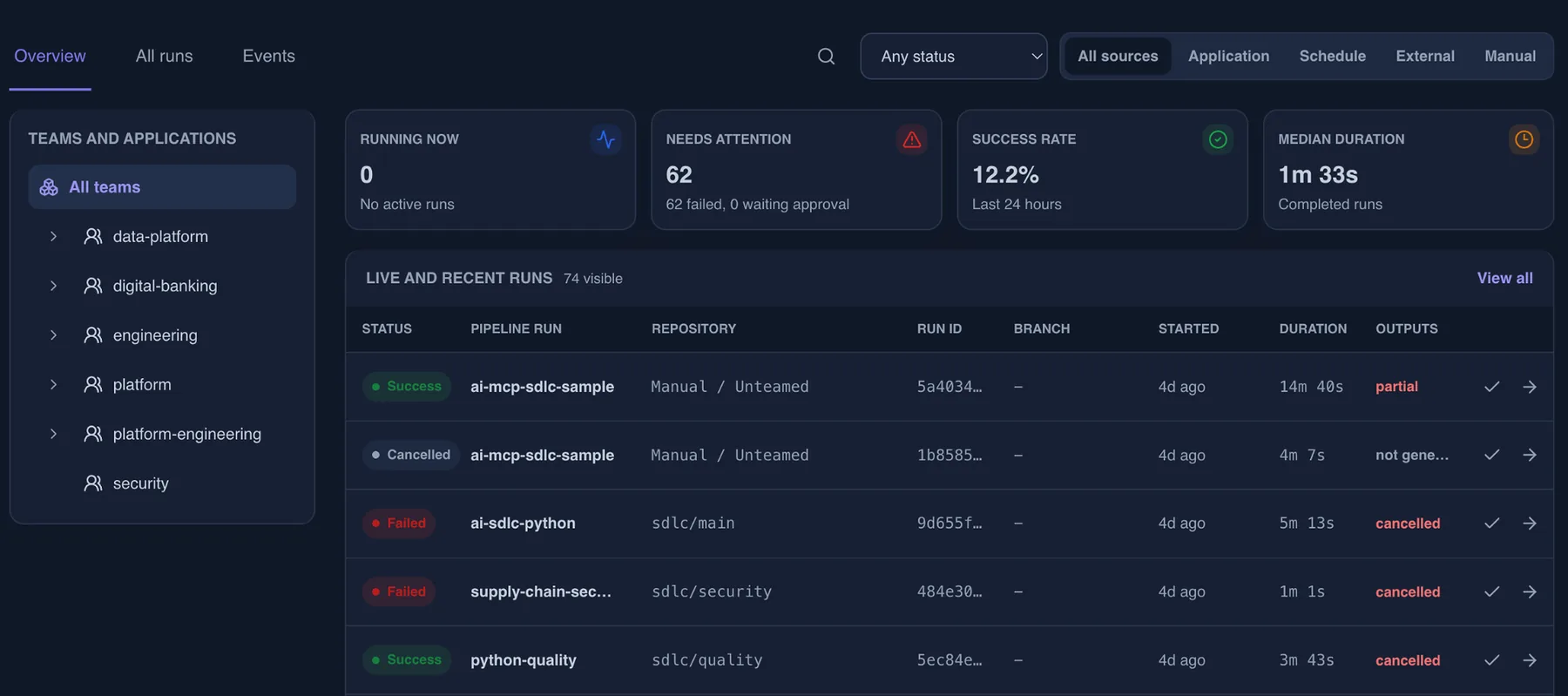
Who approved, when, and the deliverables the run produced.
← QA is blocked on unclear requirements
QA loses time reconstructing intent. Testing can start from the wrong assumption and clarification cycles cost a day or more.
A CI/CD pipeline suddenly starts failing →
Most failures are a diagnosis problem before they are an engineering problem, and diagnosis eats the first thirty minutes.
Map this workflow against your controls.
Bring the trigger, the tools it touches, the approvers, the runtime boundary and the evidence you need to keep.