

A security vulnerability scan flags an issue
One vulnerability can span many repos and teams. Manual discovery is slow, incomplete and easy to miss under SLA pressure.
The work already crosses these systems:
From scattered checks to one governed run.
Today
A security engineer exports the scan, greps repositories by hand, opens tickets one at a time, and tries to remember which teams still owe a fix.
With NopsAI
The scan becomes a pipeline gate: a security-agent profile finds affected repos with read-only access, opens team-scoped fix tickets, raises the incident for production exposure, and masks every secret.
Security triage moves from memory-driven coordination to one governed workflow.
The run, step by step.
Deterministic work first, reasoning inside the tools and written policies the pipeline bound to it, and a named human at every gate its author placed.
Trigger
The scanner posts findings to an authenticated external trigger.
Collect context
Dependency manifests across repositories are read with a read-only profile; ownership comes from team config.
Verify state
Deterministic matching confirms which repositories actually ship the affected version.
Reason
A security agent role groups findings by owning team and proposes an SLA per severity.
Approve
Raising a production incident requires approval; opening team tickets does not.
Execute and record
Tickets are created per team and an evidence workbook is produced with secrets masked throughout.
What the run leaves behind.
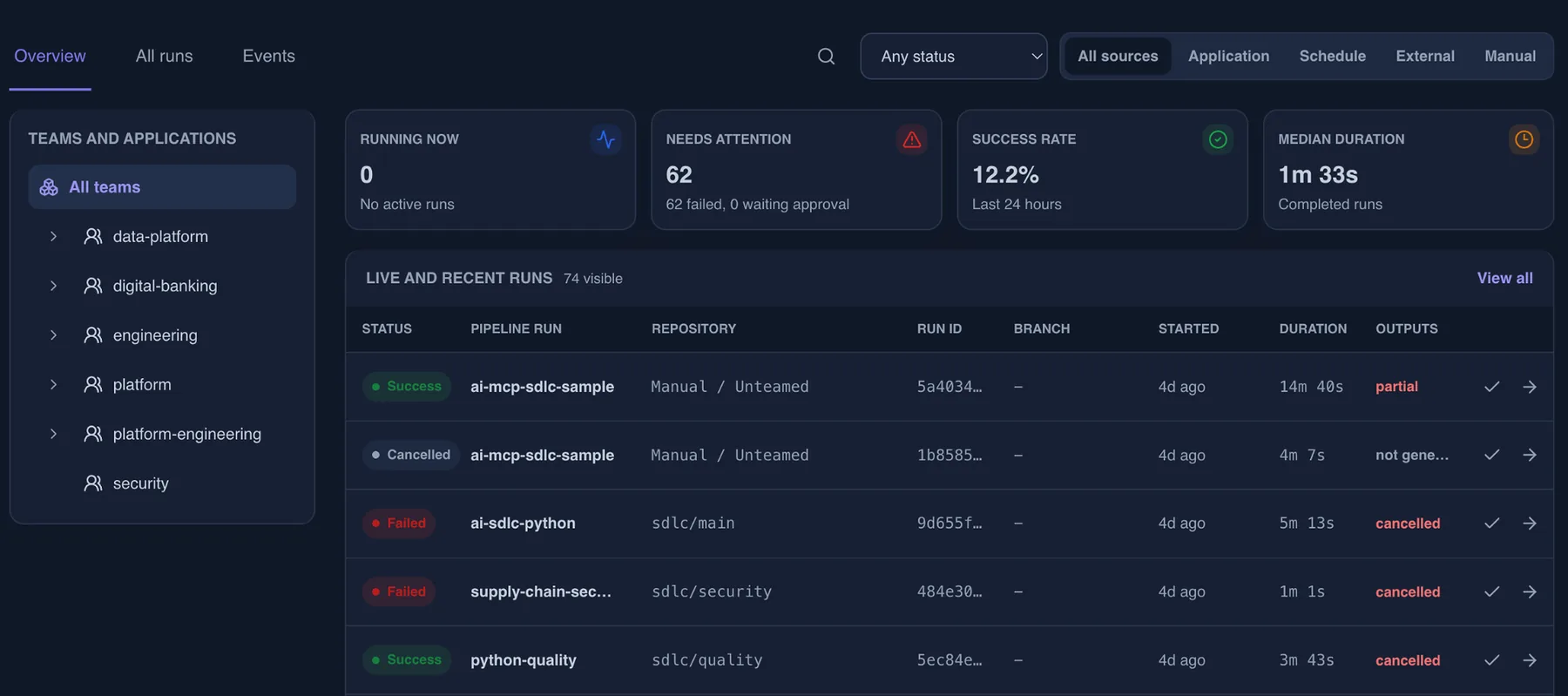
The useful part is not only the automation. It is repeatability with proof.
Trigger and subject
What started the run and which effective identity it ran as.
Authorization snapshot
Which resources were checked, and which decision each check returned.
Knowledge in scope
The guardrails, policies and runbooks that bounded each decision, stored as text with the run, plus the governance level that applied.
Tool and AI activity
Every tool call, the profile that allowed it, and the model usage it consumed.
Task history and timings
Every task, its state transitions, its duration and the logs it produced, with known secret values masked.
Approvals and outputs
Who approved, when, and the deliverables the run produced.
← Sales promises a feature that does not exist yet
Sales needs a fast answer; product needs control. Without a governed path, promises get made on incomplete information.
A new employee onboards to a project →
Docs go stale, active work is scattered, and every new hire rebuilds the same mental model on their own.
Map this workflow against your controls.
Bring the trigger, the tools it touches, the approvers, the runtime boundary and the evidence you need to keep.